


Developed by a Physical Therapist
SteadyStep™ Balance System
SteadyStep™ Balance System
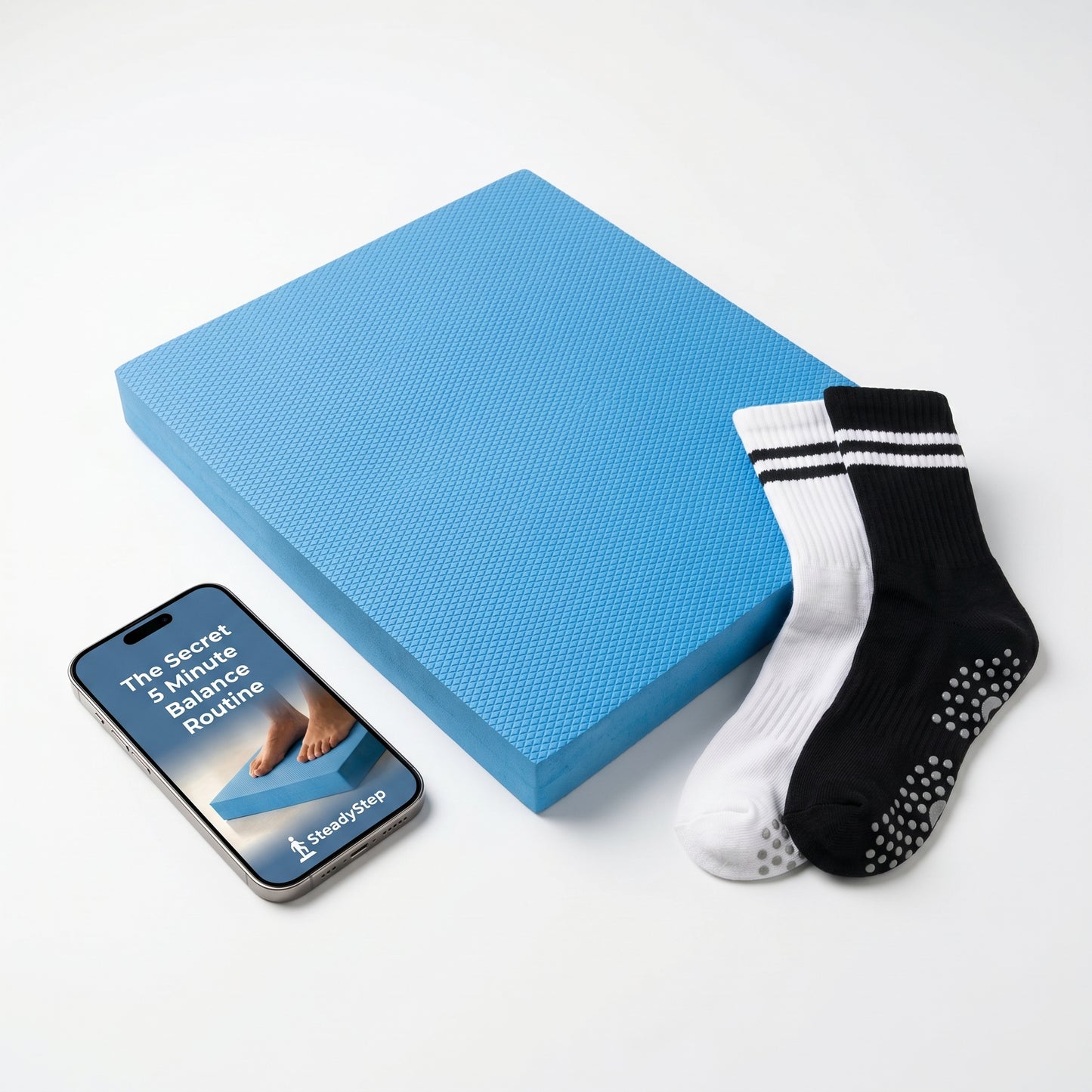
Balance Pad — ($79 value)
Secret Balance Routine — ($49 value)
Grip Socks — ($21 value)
Total Value: $149 Today Only: $69
Couldn't load pickup availability

SteadyStep™ Balance System
What's In The Box
What's In The Box
- SteadyStep Balance Pad (XL)
- Grip Socks (Two Pairs)
- 5-Minute Daily Balance Program (delivered instantly to your email)
Everything you need to start training from day one no gym, no equipment, nothing else to buy.
Materials & Quality
Materials & Quality
Premium odor-free TPE foam
XL non-slip surface — 40cm x 33cm
Durable and non-toxic — built for daily use
No chemical smell. No cheap foam.
Shipping & Returns
Shipping & Returns
Orders processed within 1-2 business days
Delivered in 8-12 business days
Not happy? Return it within 60 days for a full refund. No questions asked.
Real People. Real Results.
-
★★★★★
"I'm in my early 70s and a year ago I started noticing I was gripping railings and hesitating on stairs without realizing why. It was scary because nothing hurt, I just didn't feel steady anymore. I started using the Steady Step pad with the exercises every morning. Slow, controlled, consistent. Just a few minutes It quietly changed my confidence over a few weeks."

-
★★★★★
"Happy to tell you that I have regained my balance in four weeks. I only use the pad for about 10 minutes each morning. It is a wonderful feeling to be able to walk without the help of a walking stick now. I did not think that was possible at my age. It is. The only thing I will say is the pad seems a bit small but it's worth it."

-
★★★★★
"I am 89 years old and have had atrophied legs from prolonged bed rest as a child. I started using the pad each morning as my coffee brewed. A few minutes every day. It has helped immensely. I can now walk across a room without holding on to furniture, toe to heel. No more shuffling. Thank you, thank you."


It's Not Your Fault. Age Did This.
For most of your life your balance worked automatically. You never had to think about walking. You never had to think about staying steady. Your body just did it.
Then age happened.
After 50 your muscles get weaker, your nerves get slower. Your body starts changing in ways you can't always see or feel. And that's when your balance starts slipping.
Or maybe with age even came a health condition that started making your balance worse.
Whatever the reason, it isn't your fault. Age did this.
And if your balance fails you in that one split second when you stumble, that's when a fall happens.
This is also why walking every day isn't enough. Walking keeps you moving. But it doesn't train your balance. Those are two different things.

Why Waiting Makes It Worse
The less you move, the worse your balance gets.
And the worse your balance gets, the less you want to move.
You shuffle to feel safe. You grab the wall. You slow down on stairs. You stop walking as much.
And every time you do a little less, your balance gets a little weaker.
The only way to stop it is to retrain it.

Your Balance Can Still Be Retrained. At Any Age.
No matter what is causing your balance to slip, it can still be retrained. At any age. With any condition.
We have seen this work at 89. At 94. After fractured spines. After years of using a walker.
You just need to wake your balance back up.
That's what the foam pad does.
It's a wobbly unstable surface. So the moment you stand on it, your body has no choice but to shift and correct just to stay steady. That retrains the balance that age weakened.
You don't need to get on the floor. You don't need to be in perfect shape. Stand on it next to a counter if you need to.
A few minutes a day. That's it.
Then once that gets too easy, you pair it with a couple simple balance exercises.
And that's when everything changes.
Your balance comes back. The wobbles stop. You stop grabbing onto things just to feel safe. You stop shuffling. You stop thinking about every single step. You just walk. Naturally. Confidently. Like yourself 20 years ago.
And all of that for less than one trip to the ER.

Here's How To Use It
Step 1 — Unbox and set up
Place the pad on a flat surface near a wall or chair you can hold onto if needed. Put your grip socks on. That's it. You're ready.
Step 2 — Your first week
Just stand on the pad for 5 minutes each morning. Hold onto something if you need to. You'll feel your feet working immediately. That's exactly what's supposed to happen.
Step 3 — Week 2 and beyond
Start the 5 Minute Balance Routine that comes with your system. Four simple exercises on the pad. Follow along. Do it every morning. That's all.
Here's What To Expect
Days 1-4
You'll feel your feet constantly working just to keep you standing on the pad. That's your balance system waking back up. It hasn't felt that kind of challenge in a long time.
Week 1
Small changes start showing up in daily life. Less reaching for the counter. Feet starting to feel more aware when you move.
Week 2-3
Real changes start happening. You start gripping the railing less. Walking without holding onto furniture. Getting dressed without sitting down.
Month 1 and beyond
The shuffling goes away. The fear of falling starts to fade. You stop calculating every step. You just move. Freely. Like yourself again.

One Fall Changes Everything
Most falls don't come with a warning.
One moment you are walking to the kitchen. The next you are on the floor. And in that one split second everything can change.
1 in 5 seniors who break a hip never fully recover.
It's not just the physical injury. It's what comes after. The loss of confidence. The loss of independence. The family conversations you never wanted to have.
The worst part? Most falls are preventable.
Not by being more careful. Not by moving slower. Not by grabbing onto more things.
By retraining the balance that age quietly took away.
That is exactly what Steady Step was designed to do. Before the fall happens. Not after. Most falls are preventable. And the longer you wait, the harder it is to reverse.
There Are A Lot Of Ways To Deal With Balance Problems. Most Of Them Don't Actually Fix It.
These Are The Stories That Keep Us Going.
-

★★★★★
Neuropathy Had Her Using A Cane Even In Her Own Home. Not Anymore.
"I have neuropathy in my feet. Some days I can feel the ground, some days I can't. I started using a cane because the fear of falling became too much. Even in my own apartment I had it with me. I hated it but I was too scared to go without it.
My doctor suggested balance training so I bought this pad.
The first week I didn't notice much of a difference. I was still using the cane.
But a few weeks in I started feeling less wobbly on my feet. I could feel them moving and adjusting in a way they hadn't before.
I still use the cane outside. But not in my apartment anymore. Outside is the next goal."
-

★★★★★
At 65 She Thought She Was Too Young For This. A Few Weeks Later She Wished She Had Started Sooner.
"When I first saw this I thought it was for much older people. Im only 65 and still very active. I work, I look after my grandchildren, I walk every day. I did not think I was at that stage yet.
But I had noticed small things. Feeling wobbly on my feet at random moments for no reason. Grabbing onto things without thinking about it. Nothing serious. Just little things.
My sister kept sending me videos about balance training and I kept ignoring them. Eventually this popped up on my Facebook and I ordered it to get her off my back.
I only use it for about 10 minutes in the morning. Thats all. I just stand on it while I have my coffee.
A few weeks in those random wobbly moments started happening less. I feel steadier on my feet than I did ten years ago.
I wish I had not waited so long to try something like this."
-

★★★★★
The Shuffling Started After His Fall. Then Something Changed.
"Little tiny steps, feet barely leaving the ground. Thats how I been walking ever since my fall last year. I told myself it was being careful. My wife called it shuffling and I got mad at her for it. But she was right.
I came across this pad on Facebook. There was a man in the ad who had been shuffling just like me and after a few weeks he was walking normally again. Something about seeing that made me order it.
The first week I stood on it for about 5 minutes every day like the instructions said. I held onto the back of a chair at first but I could feel my foot moving the whole time trying to keep me steady on it.
The second week I started doing the routine that comes with it. Thats when I started noticing a real difference. My feet were lifting more naturally when I walked. Similiar to the feeling I had when I was standing on the pad.
The shuffling stopped. And I am hoping it keeps getting better from here."
-

★★★★★
She Has Parkinson's. She Is 92. And She Is No Longer Afraid Of Her Bathroom.
"After my Parkinson's diagnosis three years ago I stopped wanting to go out for walks. It felt difficult for the first time in my life. I have always been active and I just could not understand it. The less I could do, the less I did.
Around that same time the bathroom became the part of my day I worried about most. I live alone, and I know one wrong step in there changes everything.
Eventually my granddaughter noticed I stopped going outside and convinced me to try this pad.
I started using it every morning holding onto the counter. Right away I could feel my feet constantly adjusting to keep me standing on it. A bit wobbly at first but that is the whole point I think.
After a few weeks walking started feeling a little easier and I began going out for short walks again. I am still worried about the bathroom but not as much as before.
At my age that is enough for me. It has now become part of my morning routine."
-

★★★★★
He Couldn't Walk Straight Without His Partner's Help. Now He Has A New Goal.
"My fall left me with extremely bad balance. I could not walk straight without holding onto my partner. Room to room, outside, everywhere. I needed someone next to me just to move around safely.
I saw this pad on a Facebook ad and decided to give it a try. One week in I was walking without shuffling my feet and without needing my partner to hold onto.
I do have a long way to go. But a week ago I could not walk across a room alone. For me that's huge.
I am not yet driving again but that is my next goal."
-

★★★★★
After Fracturing Her Spine From A Fall, She Wasn't Sure Anything Would Help.
"After a fall that fractured my spine, I decided to get proactive to avoid another fall. It seemed strange that this pad could be helpful, but I decided to give it a try.
Within a few days I began to notice a difference. I began to feel my feet moving and adjusting while I was getting dressed in the morning. I could feel them doing what they did on the pad, shifting and catching me the way they used to.
I am not totally there yet, standing on one foot is still a challenge. But I am only a couple of weeks in.
I am definitely keeping this in my daily routine."


You got questions. we got answers.
Frequently Asked Questions
I'm scared I'll fall doing the exercises
I'm scared I'll fall doing the exercises
That is exactly why we designed it the way we did. You start by simply standing on the pad next to a wall or counter. You hold on as much as you need to. There are no jumps, no complicated movements, nothing that puts you at risk. If you can stand in your kitchen, you can use Steady Step.
It looks like it could be slippery and I could fall off it
It looks like it could be slippery and I could fall off it
Place the pad on carpet and put on your grip socks before stepping on. The carpet keeps the pad stable underneath. The grip socks keep your feet secure on top. We designed it specifically so stepping on and off feels safe, not scary.
This looks too complicated to use
This looks too complicated to use
It's not. Step one put on your grip socks. Step two stand on the pad next to a counter. That is it to start. No setup, no equipment, no instructions to read through. Most women are using it within 5 minutes of opening the box.
I don't know if this will actually work for me specifically
I don't know if this will actually work for me specifically
We have seen it work at 89. At 94. After fractured spines. After hip replacements. With Parkinson's. With neuropathy. With years of using a walker. If your balance has declined for any reason, the pad works by retraining the sensors in your feet and those sensors can be retrained at any age, with any condition.
It looks like it's made for athletes or younger people
It looks like it's made for athletes or younger people
It was designed by physical therapists specifically for people dealing with balance decline. The women using it every day are in their 60s, 70s, 80s, and 90s. Many of them started scared to stand on it. That's completely normal. You start slow, hold on, and build from there.
Does using this make me look old?
Does using this make me look old?
A cane makes you look old. A walker makes you look old. Steady Step sits on your floor for 5 minutes every morning and stays out of sight the rest of the day. Nobody sees it. Nobody knows you use it. What they do notice is that you are moving better, standing taller, and keeping up without holding on to things.
What if I try it and it doesn't work
What if I try it and it doesn't work
You are covered for 60 days. Use it every morning for two months. If you don't feel steadier, more confident, and more in control on your feet return it for a full refund. No questions asked. No forms to fill out. No hoops to jump through.
What if I have a medical condition?
What if I have a medical condition?
Steady Step has been used by women with neuropathy, Parkinson's, hip and knee replacements, osteoporosis, and more. That said we always recommend checking with your doctor before starting any new exercise routine, especially if you have a serious medical condition. Most doctors are supportive of balance training it is one of the most recommended interventions for fall prevention.